Luo Laughter "I speak of Africa and golden joys"


Friday, 29 January 2021

Latest news on Covid in Kenya ....

At the start of the pandemic, experts wasted no time in predicting that Covid-19 would quickly overwhelm Africa.   In Kenya, where millions live in crowded slums, the expectation that the country’s limited health services would soon become swamped led to many expats fleeing to their home nations in April.   That same month, the United Nations forecast that without intervention, 3.3 million Africans could die from the virus.Isolation units to house hundreds of people were hastily built across Kenya, and protective equipment was stockpiled as medics prepared for the worst.  Yet catastrophe was avoided and the huge death toll has not happened.

Dr Betty Addero Radier, chief executive of the Kenya Tourist Board, says the government’s decisive action in closing borders and effectively sealing off the country has so far, thankfully, managed to help protect citizens.  “Kenya was one of the first countries to close our entire air space, and it remained closed until mid August,” says Dr Radier.  “Kenya’s response has been swift and practical. The perception [in the West] might be that ‘Africa has suffered a lot of diseases and knows the repercussions’, but really the interventions made by our government have served us in good stead.   “There is a mindset in the Western world that says whenever anything happens, Africa is going to be the hardest hit. But Africa has been able to prove this wrong.  “What’s happening in the UK is shocking. It sounds that as if there is a lot of uncertainty as the pandemic evolves and that there is no plan. "

Kenya has so far reported just over 100,000 official cases of coronavirus infections, and of those, just 1,744 people died.  Given testing is on a more limited per capita basis then in many Western countries, it is near certain that many cases have not been detected.  Recent antibody testing suggests the virus has been far more widespread throughout Kenya than official figures have uncovered.

Nevertheless, when the overall number of deaths is compared with previous years there remains little significant discrepancy, reinforcing the reality that the country led by president Uhuru Kenyatta appears to have so far done better than its former colonial master in handling the pandemic,

Theories abound as to how Kenya - and many other African nations - have escaped the high Covid death counts seen in countries such as not only the UK but US, Brazil and India.  As well as the government’s swift Covid-stopping public health actions, scientists are continuing to look at factors including the country’s young, fit, primarily rural populations who may have been previously been exposed to pathogens.   But its public health experts know the success so far does not rule out subsequent spikes if the government, and people, do not remain vigilant. It is concern shared by others who had adopted the country as their home.

One ex pat, who fled to Germany in April before returning to Nairobi before Christmas, said “with schools reopening across Kenya, lots of foreign travel and the new Covid variants, it feels like its a matter of time before there’s a big increase.  "A lot of people fear getting tested. They think the government will force them to stop them working.”

But, so far this has not happened. A worrying rise in cases in November rapidly diminished in December, not least as a spate of cold weather ended and the sun came out, prompting less mixing indoors. The most recent figures released yesterday showed just four people had died of the virus in the previous 24 hours.  That is why, as much of the rest of the world remains stuck in miserable lockdowns, Kenya is open. Officials hope this means that it can now start slowly rebuilding its tourism sector, on which so many local jobs and livelihoods depend.  Tourism accounts for an estimated 9% of Kenya's GDP. In 2020 that figure diminished sharply. For months no foreign visitors arrived, resulting in lodges being shuttered and their suppliers facing the leanest of times.

In response, the cabinet secretary for tourism, Najib Balala, led a switch to focus on domestic visitors. He demanded swift action from his tourism officials and corralled operators to change their business model. It is a solution that many businesses, previously seeking the high-spending international market, were quick to adopt.

Thomas Silvester is chief executive of Loisaba, a 57,000 acre wildlife conservancy in Laikipia, Northern Kenya. He says domestic tourism enabled them to ensure continuity last year but international bookings are now finally returning.   “Before Christmas we opened up one of our camps, which did ok with families from Nairobi who would otherwise have been travelling abroad,” says Mr Silvester.  “We are now keeping that camp open, and we are seeing an uptick in enquiries from wealthy people seeking longer stays.”

Loisaba has also supported local communities by educating them about preventing Covid, and conducting outreach clinics to help test and treat those in need. These are vital safeguards to protect the local people who work at tourism businesses, enabling them to fully operate again one day soon.

“Tourism has really suffered badly, but we are now feeling hopeful,” adds Mr Silvester. “I think there will be pent up demand with people desperate to get out. If they’ve had their vaccine, they’ll be getting out of there and going on holiday.   “Fear and uncertainty are the enemy of tourism, but we hope the vaccine will mark an end to that worry about getting stuck somewhere. We hope to be fully open by May, following the Government’s Covid-secure protocol for tourist facilities.”   He said: “I am so proud of the Kenyan government. The country has known great tragedies before, but Kenyans are brilliant, accepting, and have shown real resilience. We’ll get through this together.”

Despite the nationwide night-time curfew having been extended to 12 March as part of the package of precautions the government continues to keep in place to combat fears of a second spike, Dr Radier echoes the message that Kenya is “open and ready to receive visitors.”   “The tourism recovery is driven by the measures other countries put in place to protect their citizens. But as soon as travel is possible again, our parks and animals are waiting. Animals have thrived during the lockdown, parks are regenerated. It’s an even richer experience to visit Kenya.”

As the pandemic approaches its first anniversary in March, the East Africa state - and much of sub saharan Africa - has suppressed the first year of a virus that has brought many of the world’s most advanced healthcare systems to their knees.   And, in having achieved that, Kenya has also proved the doubters wrong.

(from The Independent)


Saturday, 23 January 2021

2021 and perhaps another year or so of Covid ??

I'm still here !    Its a very odd winter; living alone and being on the Welsh level four lockdown !   I spent Christmas Day by myself for the first time in 40 or more years .... very odd indeed !    

At the moment, I go for the prescribed walk for a couple of hours each morning (unless its raining !)  I read books and the news on the internet, listen to the radio, attend meetings on Zoom (I never realised until recently its possible to get Zoom fatigue .... but I've got it !), watch the occasional DVD, stare out of the window, and go to the end of my drive to have socially distanced chats to passers-by.  

I wonder how my Kenyan friends are; Hands Around the World has more or less closed down 'for the duration' as was the phrase in WW2 .... so we are unable to put on fund-raising events; we can't send volunteers to our projects, and we receive scanty news from Africa.   We are sending money to some of our projects, and we trust our African partners to use it wisely, particularly to keep up the feeding programmes for orphans and the disabled children, but .... 

We get regular reports from them; one worrying thing is that with African schools Covid-closed, some of the teenage school-girls (orphans) have been getting food from 'boy-friends' in return for 'favours', and are now pregnant ... and possibly HIV+ also.  

I did a talk at a local church at the beginning of December (all people socially distanced and masked) and raised about £150 for HATW, which money has now gone into our Zambia food fund.  The money is so useful, but I really do wonder just how much people here can understand the way in which orphans live, and especially disabled children.   "Are there no food banks ?" I was asked;  "Why so many orphans with HIV ?"   "Don't the governments provide care ?"    Ahhh ..... (heavy sigh).


To change the subject completely, I've been spending my spare time (I have a lot of it !) in continuing with my African quilt.   Over several visits to Kisumu, I met up with my friend Lilian, who is a dressmaker, and she gave me masses of scraps of African wax prints .... and here are some of the blocks I've made so far, which I will eventually join on a plain background.

You can tell I like gaudy !


If I can remember from my mothers patchwork making days, I think most of my 'blocks' are based on what I believe is called 'nine-patch' design, but I'm varying it a bit and adding borders.

Ah well, it passes the time !

Sunday, 13 December 2020

Old Africa magazine and some new books !

 'Old Africa' for December 2020 and January 2021 has arrived ...


... and among the reviews, I saw one for a book called 'Peacocks and Picathartes'.  I knew that peafowl occurred in India, and that one species also occurred in central Africa.  Picathartes was a species of bird I had first heard of many years ago on a David Attenborough TV programme .... which it had taken him over 25 years to see in the wild !  How could I possibly resist this book ?!


The other book, 'Home Going' I had heard reviewed on the BBC World Service one night when I couldn't sleep .... it is two parallel stories of sisters beginning in Ghana .... one sold into slavery, the other a slave trader's wife.  It follows their descendents in the Gold Coast and on to Mississippi over two hundred years.   It came two days ago, and am already half way through it !

Another book I ordered at the same time has yet to come ... 'Kenya Kaleidoscope' .... 

Moving Giraffes

 (From The Guardian)


Marooned giraffes, fleeing flamingoes and stranded impalas: in recent years the rising water levels in east Africa’s Rift Valley lakes have become the norm, displacing people, threatening wildlife and submerging schools and hotels.

The gradual rise was first noticed 10 years ago but was accelerated by heavy rains in 2019, according to Kenya’s principal secretary in the ministry of environment and forestry, Chris Kiptoo.

This year Lake Turkana, the northernmost lake in Kenya, was six metres deeper than usual by November. The International Union for Conservation of Nature (IUCN) has described the threat to the lake as “critical”. Its 2020 conservation outlook, published this month warns: “Lake Turkana’s unique qualities as a large lake in a desert environment are under threat as the demands for water for development escalate and the financial capital to build major dams becomes available.”

Experts have also expressed fears that two other Rift Valley lakes, Baringo and Bogoria, could merge with catastrophic ecological consequences. Comparative images taken by Nasa’s Earth Observatory in 2013 and 2020 show heavy deposits of sediment along the edges of the two lakes that are now 13km (8 miles) apart, down from 20km.

A government spokesman says Lake Baringo has expanded from 176 sq km (67 sq miles) to 260 sq km, while Bogoria has expanded from 34 sq km to 45 km sq. “Lake Bogoria National Reserve … has experienced a change in the lake ecosystem, leading to marked reduction in the number of flamingos from 1.5 million to fewer than 100,000.”

Lake Baringo is a freshwater habitat that hosts fish, Nile crocodiles, and hippos. Local people rely on its water for domestic use and farming. Lake Bogoria is alkaline and home to thousands of flamingoes that depend on the blue-green algae thriving in its waters. The hot water geysers and hot springs that used to attract tourists to the region lie buried underneath.

“Should the two lakes ever merge, fresh water from Baringo would dilute the alkali in Bogoria and reduce the growth of algae,” says Mark Boitt, a geographic information system expert. “Several years ago, a similar rise in the waters of Lake Nakuru caused millions of flamingoes to flee the lake for Bogoria. But for how long can they keep on moving? We stand at the threshold of rapid loss of biodiversity around the lakes.”

Already, the rising water levels in Baringo have affected wild animals residing on the lake’s Longcharo island as the waters reduce the size of the island and the areas for them to forage. In September, wildlife authorities relocated ostriches, impalas and warthogs to a conservancy on the mainland. Earlier this month, two of the eight giraffes marooned on the island were also moved to safety.

Several years ago, the rising waters of Lake Nakuru caused flamingoes to leave the lake and settle in Lake Bogoria.
Pinterest
 Several years ago, flamingoes fled the rising waters of Lake Nakuru. Now their numbers are dropping on Lake Bogoria. Photograph: Baz Ratner/Reuters

“Moving a giraffe is a delicate process. We have to survey the habitat and make sure we anchor the barge in a manner that makes it easy for the giraffes to enter without causing them unnecessary stress,” says Jackson Komen, a warden for the Kenya Wildlife Service in Baringo. “It took a whole day just to move one giraffe, with the barge taking at least two hours to get to the mainland. The remaining ones, including some pregnant females, will be moved a little later.”

The government has appointed a multi-agency technical committee to investigate the cause of rising water levels in the lakes, with the final report due for release in the coming days.

Silas Simiyu, a local geologist, says human activity around the water catchment areas is a key reason for the rising water levels.

“We may be talking of increased water volume but forget that it is the lakes’ capacity to hold water that has reduced. Water from underground aquifers has always risen depending on the tectonic movement cycles. But never have the lakes been silted as they are today,” says Simiyu. “Rather than act like deep bowls that can hold more water, the lakes are becoming wide, thin-rimmed pans due to siltation.”

A warden from the Kenya Wildlife Services walks back from the point where the main road into the Lake Nakuru National Park is submerged in floodwater.
Pinterest
 A warden from the Kenya Wildlife Service walks on the flooded main road into Lake Nakuru National Park. Photograph: Tony Karumba/AFP/Getty Images

He says: “Some talk of increased rainfall, but the ongoing rains are not the heaviest to be witnessed in these areas. Let us accept that our own activities have exacerbated the problem.”

Susan Jepkemoi, an environmental scientist with the Great Rift Centre for Research and Development, says the population increase has come with demand for more farmland, and more people have settled close to the lakes.

“Change in land use without regard for the environment will have serious climatic consequences on these lakes,” she says. “People around the lakes continue to cut down trees for charcoal burning. This depletes the ground cover leading to flooding. The runoff water takes with it the top soil to the lakes, the lowest points in the Rift Valley, and leads to silting.”

The phenomenon has brought upheaval for local communities. As the water has pushed further inland, grazing fields have continued to shrink and churches, schools and hospitals that were in use at the start of the year now lie in ruins.

“Take a boat ride here and chances are that you will be riding on top of multi-storey buildings, the relics of a lost city,” says Francis Cherutich, a tour guide in Baringo.

For 83-year-old Kangogo Arap Kipotota, his small grocery shop at Kampi Ya Samaki township doubles as his home. His former house lies submerged several miles from the shop. He remembers the lake swelling in 1961, but nowhere near the current levels. Back then, it was a long walk to get to the lake. Now it is almost at his shop. Like other residents, he fears he may have to move to higher ground again.

“The lake was so far out that I would graze our sheep and goats beyond that tree,” he says, pointing to a tree trunk more than 500 metres from his shop. “We would walk in the shallow edges of the lake. You cannot try that now since crocodiles and hippos have become our closet neighbours.”

Both lakes are Important bird areas that attract thousands of ornithologists from all over the world. However, a 2019 assessment of Baringo and Bogoria by BirdLife International put their threat status as “very high”.


A fisherman paddles a traditional raft made from reeds past one of the submerged buildings of the Soi Lodge on the shores of Lake Baringo.
Pinterest
 A fisherman paddles a traditional raft made from reeds past one of the submerged buildings of the Soi Safari Lodge hotel on the shores of Lake Baringo. Photograph: Tony Karumba/AFP/Getty Images

The local hospitality industry has also been hit hard by the rising waters. Hotels and lodges that relied on tourism have been either partly or completely submerged. At Soi Safari Lodge in Baringo, the only visible part of a hall styled after the traditional African hut is the roof. As recently as July, the building stood 800 metres away from the original lake’s shoreline.

“Covid-19 took away the hotel business. Now the lake has taken the hotel. And there seems to be no end to the lake’s encroachment on the properties,” says Peter Chebii, a manager at the hotel.

With no sign of the waters receding, Boitt warns: “We have failed to protect the environment and are now reaping the bitter fruits. We either reform or lose our livelihood when the land – laid bare through over-cultivation – fights back using the lakes. Only we can put on the brakes. But can we?”

Saturday, 24 October 2020

Don't believe everything you read in the papers !

https://www.dailymail.co.uk/news/article-8871853/Elephant-chases-car-startled-Kenya.html


(I hope that loads ....)   

Look to see the inaccuracies in the above news report. 

Its single frames from a film; the cars were not moving (look at the position of the stones on the road); and its a bull, not a female .... he's almost certainly in musth .... his facial glands are oozing, and I think that's urine dribbling down his back legs .... both signs of a sexually aroused bull elephant !

But .... its not wise to get that close to an ellie at any time !   

Thursday, 22 October 2020

So un-necessary, so cruel .... and so ill-legal


Thousands of girls have been subjected to female genital mutilation during a month long “cutting season” in west Kenya, activists have warned, amid fears the Covid lockdown has triggered a dramatic surge in new incidents. 

Every day for almost four weeks roughly 100 girls have been pushed to undergo FGM - a dangerous non-medical practice where a girl's genitals are cut - in Kuria, a district on the Tanzanian border some 50 miles from Lake Victoria.

Girls as young as nine are dressed in patterned fabrics, tinsel and balloons and paraded through the streets, surrounded by a throng of dancing adults and children. Many men carry machetes to deter interventions.

“These parades are very loud, with music and dancing, but they are also very hostile,” says Natalie Robi Tingo, founder of Msichana Empowerment Kuria, an organisation working to end FGM. She estimates that around 2,800 girls have been cut over the last three and a half weeks.

“To begin with families were concealing the practice, but by the second and third week girls were being paraded openly on the streets as there had been no repercussions,” she adds. “I became an activist nine years ago and I have never seen anything like this - both in scale and visibility. It's heartbreaking.”

Kenya has been held as a “beacon of hope” amid efforts to eradicate cutting across the globe. The government made FGM illegal 10 years ago, while the President has committed to eradicate cutting by 2022.

But Ms Robi Tingo says the practice was pushed underground in some hotspots - including Kuria, West Pokot (in northwest Kenya) and Loita (south of Nairobi). The coronavirus pandemic has provided cover for FGM to resurface on a huge scale.

School closures mean children are at home all day, so parents have an opportunity to cut girls without worrying that it will be noticed,” Ms Robi Tingo says. “Normally cutting takes place during the school holidays in November and December, but this year we've seen it happen in April too - and now.”

Instability has also contributed to the surge. Some community elders have reportedly blamed Covid-19 on a failure to uphold traditions, including FGM, that are believed to appease the gods, while families in dire economic straits are cutting their daughters to gain a higher “bride price”.


Female genital mutilation | The facts

Female genital mutilation (FGM) includes procedures that intentionally alter or cause injury to the female genital organs for non-medical reasons
The procedure has no health benefits for girls and women and the United Nations recognises the practice as "a violation of the human rights, the health and the integrity of girls and women".
It can cause severe bleeding and problems urinating, and later cysts, infections, as well as complications in childbirth and increased risk of newborn deaths
More than 200 million girls and women alive today have been cut in 30 countries in Africa, the Middle East and Asia where FGM is concentrated
FGM is mostly carried out on young girls between infancy and age 15
The practice is recognised internationally as a violation of the human rights of girls and women
FGM is outlawed in half of the 30 countries where it is most prevalent yet there have been few prosecution
Delays in anti-FGM programmes due to the coronavirus pandemic means that two million girls who would otherwise be safe from the practice could be at risk over the next decade, according to the UNFPA, the United Nation's reproductive health agency.


Source: World Health Organization


“At a community level FGM is about financial incentives and gains,” says Nimco Ali, chief executive of The Five Foundation, The Global Partnership To End FGM. “When a young girl is cut it is not to protect against rape, as some claim, but to protect an asset - her virginity - so you can sell her at a higher price.”

FGM is also lucrative for those behind the practice. Cutters are paid around 1,000 Kenyan shillings, about £7, for every procedure they perform and in some areas community elders get a percentage of this cash.

“So you can imagine right now when well over 2,000 girls have been cut, that means more than two million Kenyan shillings (around £14,000) has been collected,” says Ms Robi Tingo. “Many girls also receive small change or gifts at these parades, so there's some encouragement there too.”

Providing economic opportunities is central to ending the practice, lifting communities out of poverty and changing minds about the value of women, adds Ms Ali.

“We have to give women in Africa access to economic empowerment, education and sanitation to counter this, because right now they're being treated as a burden,” she says. “There's this idea they're only value is in being mutilated and sold into marriage. I'm not sure why this isn't shaking us to our core.”

Ms Ali - who was appointed by the UK government as an independent adviser on tackling violence against women earlier this month - adds that the foreign secretary, Dominic Raab, should apply more pressure on Kenya to maintain vigilance around FGM, even as the pandemic draws attention and resources.

“Kenya is a commonwealth country and the UK is respected in Kenya,” she says. “We have a responsibility to help. I think we can offer a lifeline to these girls.”

Thursday, 15 October 2020

Disinfecting school children ??

From the Daily Telegraph:-

Kenyans are reacting with anger to a video showing students being sprayed with disinfectant that they say could be harmful.

The issue highlights the dilemma facing schools in Kenya – and around the world – as they try to resume education in a way that does not risk the continued transmission of Covid-19.

As schools reopened Monday in Kenya, female students wearing face masks in one school appeared to be showered with disinfectant pumped from a pesticide sprayer, to the ire of parents online.

"How did adults sit down and decided that spraying children like this contains #Covid19? What happened to running water and soap?,”

Reacting to the outrage at the daily Covid-19 briefing on Tuesday, Dr Rashid Aman, the administrative secretary at the Kenyan health ministry warned schools against spraying methods. “Those chemicals should not be used on humans…only on surfaces,” he said.

Back in February in the early days of the coronavirus, students at a Lebanese school were sprayed in a similar manner to the annoyance of many.

In an update to its Covid-19 guidelines in May, the World Health Organization warned that spraying disinfectants which contain toxins on people could be “physically and psychologically harmful”.

Side effects could range from eye and skin irritation to gastrointestinal effects, according to the update. The Africa CDC also issued a report against the use of disinfection cubicles, an early Covid-19 innovation that was popular in African countries but that the agency said could expose people to harmful chemicals.

Kenyan schools opened back up this week after the government rescinded on July pronouncements that the school year would be scrapped altogether.

Sunday, 11 October 2020

Update on African Covid cases

 As readers know, I receive news from the Mill Hill Missionaries and from the Kenya newspapers, which keep me up to date with how Kenya and Africa are coping with Covid-19, the coronavirus pandemic.   This caught my attention .... 


Africa’s Astonishingly Low Covid-19 Death Rates Explained

Africa accounts for 17% of the global population but only 3.5% of the reported global COVID-19 deaths. All deaths are important, we should not discount apparently low numbers, and of course data collected over such a wide range of countries will be of variable quality, but the gap between predictions and what has actually happened is staggering. There has been much discussion on what accounts for this.


As leads of the COVID-19 team in the African Academy of Sciences, we have followed the unfolding events and various explanations put forward. The emerging picture is that in many African countries, transmission has been higher but severity and mortality much lower than originally predicted based on experience in China and Europe.


We argue that Africa’s much younger population explains a very large part of the apparent difference. Some of the remaining gap is probably due to under reporting of events but there are a number of other plausible explanations. These range from climatic differences, pre-existing immunity, genetic factors and behavioural differences.


That makes sense .... that younger populations don't get infected so easily, and we know that in Europe and the U.S., many people have existing health problems, such as diabetes and obesity, or are old, which makes them more likely to be easily infected with Covid-19.

Wednesday, 16 September 2020

African Writers

The BBC has recently had many programmes on TV and the radio about the history of African writing .... books written by Africans, not by white writers writing about Africa.   I am at present listening to one of Chinua Achebe's books on Radio 4.

I originally encountered books written by Africans in 1968, and this is the first one I bought:


The orange paperbacks, published by Heinemann Educational Books, were to become a familiar sight in Kenyan bookshops.   Priced in the UK at 5s.6d, (or 7 Kenya shillings) I suppose they were out of reach of the average African student, but they soon appeared in most school libraries. 

I quickly got 'hooked' and every trip to town I bought another, and eventually had quite a number !  I found some written by James Ngugi, a Kenyan writer, who later renamed himself Ngugi wa Thiongo.   Some of these books I found quite disturbing, as they showed me how Africans viewed Europeans,  and didn't always make pleasant reading, but then books written by Europeans about Africans must have been equally disturbing to African readers, when they dealt with topics like Mau Mau, and the independence struggles in most ex colonial countries.   


Now, there are modern African writers like Chimamanda Ngozi Adichie writing about their own countries troubled past .... such as her book 'Half of a Yellow Sun', which is a novel about the Biafran war in the 1960's, and 'Purple Hibiscus' with its background of a military coup in Nigeria.    She has won many literary prizes ....


.... and like Maaza Mengiste of Ethiopia and Tsitsi Dangarembga of Zimbabwe, both long-listed for the Booker this year, its time Adichie was also seen on the Booker lists.


Wednesday, 9 September 2020

Twenty-five years ago .... Father Hans epic walk

(From the Mill Hill news)


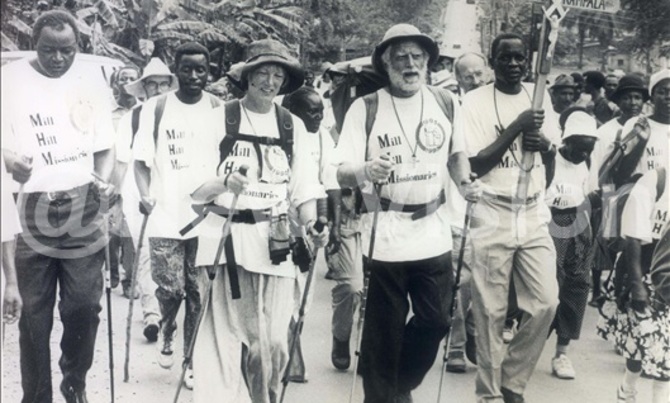
Today In History: 60 Mill Hill pilgrims walk from Mombasa to Mengo


By Admin
Added 6th September 2020 05:04 PM
The pilgrimage was marking 100 years since the first Mill Hill missionary, Bishop Henry Hanlon arrived in Buganda.  
Today In History: 60 Mill Hill pilgrims walk from Mombasa to Mengo
50 days on foot. 60 pilgrims led by father Hans Burgman (centre in hat) walking on September 6,1995
Today in History (September 6, 1995)

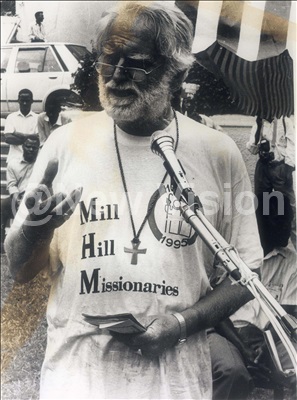
Sixty Mill Hill mission pilgrims who trekked from Mombasa to the Buganda King's court at Mengo arrived at Bulange to a rousing welcome from Lukiiko members and a cross section of people.

Prince Lincoln Abraham Ndawula, Kabaka Mutebi's uncle, received the pilgrims on behalf of the King who was out of the country. 

The pilgrims, led by Rev Father Hans Burgman, walked the 1,400km from the East African coast to Buganda in 50 days.


Father Hans Burgman, Leader Of The 60 Pilgrims Who Walked From Mombasa. He Was Speaking At Bulange On Wednesday September, 1995 (2)

The pilgrimage was marking 100 years since the first Mill Hill missionary, Bishop Henry Hanlon arrived in Buganda.  

The Pilgrimage was also in commemoration of September 6, 1895, the day Kabaka Mwanga met the early pilgrims in his court.

13 Pilgrims came from the Netherlands, four from England, two Ireland, two Scotland, four from Tyrol and 25 from Kenya.


Saturday, 5 September 2020

Hurrah ! They've come; 88, 89 and 90 of Old Africa magazine .... and news of Rift Valley lakes flooding


Three issues of my favourite magazine, presumably Covid/flights from Kenya delayed, but they caught up with each other and all arrived together.   I've emailed Shel Arensen, the editor, to tell him they are safely here.   

Which to read first ?   I've had a quick flick through .... I suppose I ought to read issue 88 first.   I've spent many hours during Covid lock-down reading my way though all the old issues I have, and the Soysambu book I mentioned on another blog entry .... 

~   ~   ~   ~   ~ 

Rift Valley, Kenya - It was seven years ago when Job Chebon, owner of a tourist lodge on the edge of Lake Baringo, first noticed the waters near his property rise dangerously.

"The water would come and then recede. For years, it would come a little bit further to dry land, to our homes, then go back," he said earlier in August, standing on a sandbag leading to the flooded reception lobby of his Soi Safari Lodge - at least, what remains of it.

"In 2020, it has come with a vengeance."

The rising waters of Lake Baringo in the Great Rift Valley have dealt a heavy blow to tourism, a key sector in this part of Kenya.

Chebon said he had lost thousands of dollars in accommodation fees and damage to his property, while several other hotels in the region have also been either totally or partially submerged.

The tourism sector of the region has taken a huge hit [Daniel Munene/Al Jazeera]

Elizabeth Meyerhoff, a social scientist, who along her husband Murray Roberts, has been studying the lake since 2013, said the water level has been rising at about 2.5cm (0.98 inches) a day.

"In the last seven years, [it] has raised to about 9-12 metres (30-39 feet)."

The couple, who live next door to Chebon's lodge, have also been running a programme aimed at rehabilitating semi-arid environments by producing dry land seed which they have already distributed to more than 900 farmers.

Almost all the land where the grass, mostly meant for grazing was planted, is underwater. The couple’s stores, offices and a dispensary have had a similar fate.

"The water comes from the rivers, but because of deforestation it's bringing down huge amount of flash flooding with sediments which fill the bottom of the lake," said Meyerhoff, after a tour on a boat - a mode of transport that is the new norm in these parts of Baringo.

Climate change and unusually heavy rains this year have also contributed to the problem.

The rising waters have displaced more than 5,000 people in 2020, according to government officials, submerging homes, schools, roads, hospitals, farmland - and even entire islands.

The rising waters of Lake Baringo have displaced thousands of people, submerging homes, roads and farmland among others [Daniel Munene/Al Jazeera]

"This island was whole, we could move around," said Nongaseuria Lenaisiaku, an elderly lady who has had to relocate to higher ground twice after Kokwa Island was split into three parts.

"Now the water has separated us from our relatives. I don't even have a boat take me to other parts of the village."

Nearby, in Rugus, another fishing village of mud-thatched huts, Singh Lenapunya was seated on his raft - scaling fish he had just caught. He acknowledged that the rising waters have brought along plenty of fish - but also crocodile and hippos. A herdsman was recently killed by a crocodile.
Lake Bogoria rising

However, it is not just Lake Baringo and its dependents that are in trouble.

Further to the south, Lake Bogoria - a World Heritage site which at times hosts up to 1.2 million flamingoes - has also been rising. Just a few years ago, Baringo and Bogoria - freshwater and alkaline lakes, respectively - were 20km (12 miles) apart, but local officials say that distance has now been cut to 13km (eight miles).

Located on an eponymous national reserve, Lake Bogoria is a significant tourist attraction, whose hundreds of bird species and beautiful landscape, as well as geysers and hot springs, draw visitors from many parts of the world.

Lake Bogoria is a major tourist attraction [Chaterine Wambua-Soi/Al Jazeera]

According to James Kimaru, the game reserve's senior warden, the lake has expanded from 34 square kilometres in 2017 to 43 square kilometres in 2020.

"Almost 80 percent of the hot springs are under water, especially the main ones which were shooting almost three metres up," said Kimaru. "They used to be our main tourist attraction but now the number of visitors has reduced. The main road, the gate to our reserve and our offices are under water - we have to move for a second time. The hospital, hotels and homes adjacent to the reserve are also submerged."

Meanwhile, there are growing concerns about the swamps between the lakes. Both Meyerhoff and Kimaru said if the alkaline water from Bogoria reached the swamps which link to Baringo's freshwater - it would be an ecological disaster.

With both lakes having no known channels that allow the flow of excess water, some scientists have suggested building a barrier between them. Others have recommended constructing a canal for water to flow out of Lake Baringo, which is rising faster. They say the water can be channelled through a natural course outlet further north.

It is still unclear, however, what the effect of such a move would be on Kenyan farmers and pastoralists downstream, as well as the lake itself.

Government officials told Al Jazeera they are examining these suggestions, while also carrying out a study to find out whether there are other reasons why the lakes are rising so fast to determine safe solutions to protect them and the millions of people whose lives are at stake.

Back in Soi Safari Lodge, Chebon said he is afraid that it is only a matter of time before his entire property - and with it, his entire livelihood - is swept away by the rising waters.

(Report from AlJazeera)