Some good news after a very tense (and as yet unresolved election):-
Breast cancer survivors are in a self-help group knitting 'knockers' (and yes, that's what womens breasts are often called in Kenya !) to replace unsatisfactory silicone prosthesis.
http://www.bbc.co.uk/news/av/world-africa-41778299/knitting-knockers-for-kenyan-breast-cancer-survivors
There are even men joining in with the knitting.
Luo Laughter "I speak of Africa and golden joys"
Tuesday, 31 October 2017
Friday, 27 October 2017
The election, continued ....
Apart from reading what the BBC and the Kenyan newspapers are saying about the election, I have had an email from a (white) missionary friend who lives near Kisumu.
Here's an extract of what he has said to me today, after I quoted to him what my Luo friend had written to me a few days ago:- (I've added a couple of explanatory links).
"I echo your friends sentiments, no one feels safe. Uhuru and his people are using Mungiki https://en.wikipedia.org/wiki/Mungiki in police uniforms to harrass, batter and kill Luos. Today in Kisumu alone there were 200 armed police. l had hoped after Dr Akombe http://www.nation.co.ke/news/IEBC-commissioner-Roselyn-Akombe-resigns/1056-4144480-7lyoqhz/index.html ran for her life and said what she did, backed by the Chairman of the IEBC, that people would stop and think and the election would be postponed, instead even UK and USA embassies pushed for it to go ahead. The helicoptor that crashed in Lake Nakuru was full of ballot papers. The same people who rigged the election before are still in place.
l hate the Demos, but if you speak out, you are dead. A Catholic priest spoke out about the Luo killings by the police; he disappeared that day and was found out near Kibos with cuts to head and body, car burnt out and he died at the Russian Hospital. He had no ID or identity on him, why would anyone want to kill a harmless priest? Its become a police state and they are determined to have their way, but a lot of blood is on their hands, and God won't listen to our prayers.
I was here in 2007 and 2008, tribalism has brought hatred and division to Kenya and l worry about the amount of ethnic violence; we could have another Rwanda erupt, as people here are so angry and refusing to recognise Uhuru or his ministers. They have said no Demos, no burning tyres, but it continues, where it will all end ? l am so worried for them; l'm more African than English and they are like my own family and people, they are suffering, but determined to make a stand. l just pray that God will bring justice and intervene in the events here."
Here's an extract of what he has said to me today, after I quoted to him what my Luo friend had written to me a few days ago:- (I've added a couple of explanatory links).
l hate the Demos, but if you speak out, you are dead. A Catholic priest spoke out about the Luo killings by the police; he disappeared that day and was found out near Kibos with cuts to head and body, car burnt out and he died at the Russian Hospital. He had no ID or identity on him, why would anyone want to kill a harmless priest? Its become a police state and they are determined to have their way, but a lot of blood is on their hands, and God won't listen to our prayers.
I was here in 2007 and 2008, tribalism has brought hatred and division to Kenya and l worry about the amount of ethnic violence; we could have another Rwanda erupt, as people here are so angry and refusing to recognise Uhuru or his ministers. They have said no Demos, no burning tyres, but it continues, where it will all end ? l am so worried for them; l'm more African than English and they are like my own family and people, they are suffering, but determined to make a stand. l just pray that God will bring justice and intervene in the events here."
~ ~ ~ ~ ~
And the election for the four counties of Homa Bay, Migori, Siaya and Kisumu which WAS going to be held on Saturday (tomorrow) has again been postponed to a date as yet to be announced, for security reasons.
Thursday, 26 October 2017
So the election is over .... except ....
Its cynical to report that not many people were killed by the police/armed forces today, but I suppose it could have been far worse. Four counties, Homa Bay, Migori, Siaya and including the city of Kisumu constituencies, in the Luo dominated west of the country, had no voting for a variety of reasons .... ballot papers hadn't been delivered; officials had stayed away after threats on their lives; there were no ballot boxes, and several other reasons ... including the call by the NASA (opposition) leader, Raila Odinga, to boycott the re-run election because the Supreme Court had not yet delivered a final ruling on the August election. It has been said that voting in these counties will now take place on Saturday.
Armed Police looking for protesters in the Kibera slum, Nairobi
Protests, riots and demonstrations took place in many areas of NASA support, including Kibera in Nairobi, Mombasa and all over Kisumu .... I heard later today that someone was shot in Mamboleo, where I have friends, and also in the Nyalenda slum, where I used to go on a Sunday evening to play the Dutch game shulbach, with Father Hans and African friends.
So what are the implications of this election ? Well, corruption and the 'big men' having Swiss bank accounts into which they pour ill-gotten fortunes, are just a way of life in most African countries, as is the grinding poverty of the majority. But as Fergal Keane said in the report I posted yesterday, the implications don't only affect Kenya, they have serious implications for the fight against terrorism in Somalia and, potentially, for the aid operations in South Sudan.
What will happen after the extra voting (if it goes ahead) on Saturday ? We wait with bated breath ....
Wednesday, 25 October 2017
Two more emails .....
.... one from the Kenyan friend I quoted yesterday; he tells me that he and his family are on lock-down in their house in Nairobi. I assume that he is typical of many Luo living in what is mostly an 'opposition' area, fearing what might happen if he goes out on the streets.
And another email, from an ex-Kenya retired priest friend in Holland, tells me that a priest has been murdered near Kisumu. I checked in the Daily Nation and found this report:-
"A Catholic priest died on Monday night after he was found unconscious near a sugar plantation in Kisumu East. Father Evans Juma Odour, the Presiding Priest of Nyabondo Parish in Nyakach, was found unconscious with deep cuts on the head, face and hands. He was rushed to Jaramogi Oginga Odinga Teaching and Referral Hospital where he was pronounced dead.
The cleric is said to have been carjacked and tortured by unknown assailants who dumped him at the sugar plantation then drove his car to a different location and set it ablaze.
According to a relative who did not want to be named the priest had dropped her at Chiga and was on his way back to Nyabondo when he was accosted by his killers. Shocked congregants took to social media and expressed their anger at the manner in which the cleric was felled. ”Why kill the man of God, it is so sad. We were recently with him at a funeral of a relative, very calm and collected man,” said Jane Nyagingo."
~ ~ ~ ~ ~
And another email, from an ex-Kenya retired priest friend in Holland, tells me that a priest has been murdered near Kisumu. I checked in the Daily Nation and found this report:-
"A Catholic priest died on Monday night after he was found unconscious near a sugar plantation in Kisumu East. Father Evans Juma Odour, the Presiding Priest of Nyabondo Parish in Nyakach, was found unconscious with deep cuts on the head, face and hands. He was rushed to Jaramogi Oginga Odinga Teaching and Referral Hospital where he was pronounced dead.
The cleric is said to have been carjacked and tortured by unknown assailants who dumped him at the sugar plantation then drove his car to a different location and set it ablaze.
According to a relative who did not want to be named the priest had dropped her at Chiga and was on his way back to Nyabondo when he was accosted by his killers. Shocked congregants took to social media and expressed their anger at the manner in which the cleric was felled. ”Why kill the man of God, it is so sad. We were recently with him at a funeral of a relative, very calm and collected man,” said Jane Nyagingo."
~ ~ ~ ~ ~
... and then there is the report about the non-fatal shooting of the driver/body-guard of a deputy chief justice ....
~ ~ ~ ~ ~
I weep for Africa –
Whose mountains are scarred by greed
And whose deltas are slick with corruption
Because power is like cancer.
BBC report on the election tomorrow:-
This week's presidential election re-run in Kenya has implications not only for the country but also for much of the continent, says the BBC's new Africa editor, Fergal Keane.
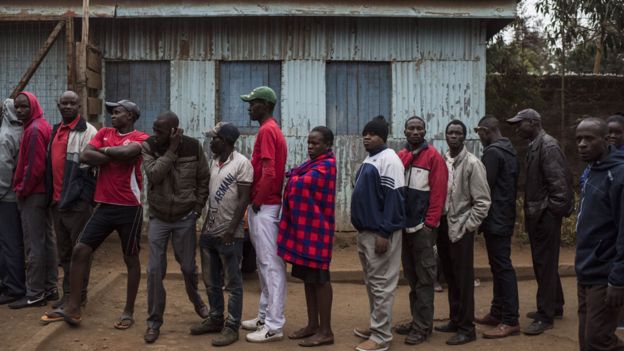
The last days have passed in a swirl of chanting crowds, arguments in the courts, and meetings between powerful politicians and election commissioners. The tension ahead of the polls crackles like static on the streets of Nairobi.
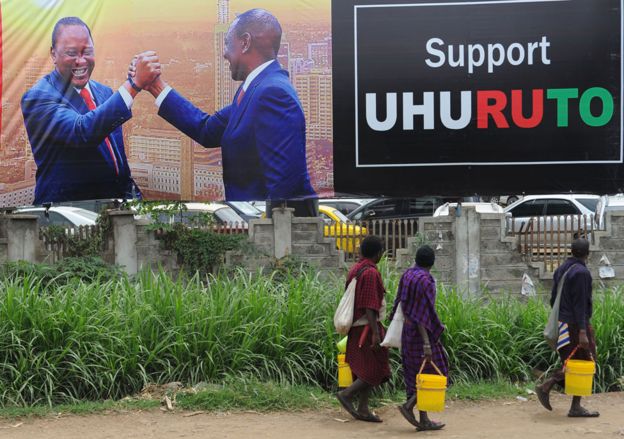
At the Githurai junction on the city's outskirts, several thousand people gathered to cheer President Uhuru Kenyatta. Passing cars were surrounded and plastered with party stickers. Briefly enmity flared. A man leaned out of a passing coach and drew his finger across his throat, shouting abuse at the President's supporters. They surged forward but bus and man were quickly gone.
The days tremble with rumours. The election may happen. Or it may not. The Independent Election Boundaries Commission has warned it can't guarantee a credible poll in the prevailing circumstances.
Old friends I have spoken with express alarm at the rise in ethnic antagonism. International diplomats seem in a quandary - fearful of election day violence while acknowledging that the fresh poll was ordered by the country's highest court.
Image copyrightGETTY IMAGES
When I first reported from Africa, back in the Cold War days of the 1980s, there were only very occasional elections, usually resulting in the return of the incumbent with 90% or more of the vote.
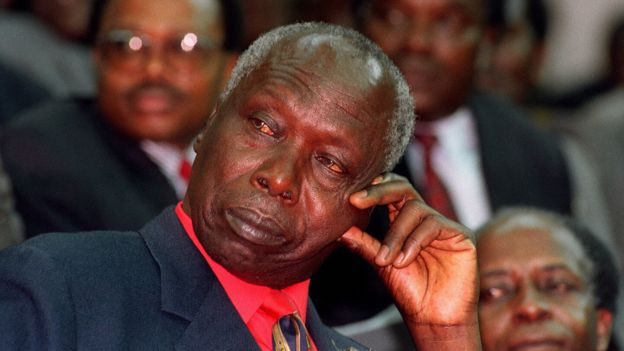
So when Kenya had its first democratic election in 1992, it was easy to be carried along by enthusiasm for the new age. After all, President Daniel arap Moi had been in power for 14 years, during which time there had been a long spree of looting of state assets, worth billions, by an entrenched elite connected to the ruling party.
Political enemies were locked up and worse. But Moi was elected - twice. He knew how to manipulate tribal rivalries to his advantage - and his party machine had very deep pockets. Still there was now at least the possibility of democratic change.
Image copyrightGETTY IMAGES
Across Africa it seemed as if a new order of accountability was coming. The great kleptocrat Mobutu Sese Seko had been swept from power in the Democratic Republic of Congo. The apartheid state in South Africa was transformed into a multi-racial democracy.
I had met Mobutu and Moi and the leaders of the apartheid regime in South Africa and witnessed the brutality and bribery through which power was maintained in much of the continent. I had also listened to diplomats, among them representatives of Her Majesty's government, tell me that President Moi at least guaranteed stability in Kenya. He kept the tribes from tearing each other asunder.
The French would have told you the same thing about any of the despots they supported in Francophone Africa. It was an attitude of mind rooted in deeply patronising attitudes towards Africans, and it ignored the role of foreign interests in creating much of the mess
But Africans were hungry for change. The Cold War had ended and with it the sorry history of support for despotic regimes by both the West and the Soviet bloc. Some of the new leaders came to power through war, but in those heady days of the late 1990s all the talk was of democratising.
The most remarkable movement in the continent's post-colonial history was not led by warlords or tribal chiefs but by a generation of Africans who believed their destiny would be shaped by their own actions. From Accra to Johannesburg to Nairobi, and thousands of points in-between, civil society began to mobilise.
I watched the Kenyan campaigner John Githongo forensically detail the corruption of the ruling elite and publish his results. In the remote Congolese village of Kachanga I met a women's association treating victims of mass rape and gathering evidence against the perpetrators.
The idealistic and energetic also mobilised around issues like the environment, economy, health and free media. The pace and dynamics of change were dictated by the internal realities of each state. But an overarching theme became apparent - the one-party state was becoming the exception.
Image copyrightGETTY IMAGES
The essential change was psychological. Young Africans saw themselves becoming agents of change much as their forebears had done in the years around, and just after, the end of colonialism. Two decades ago I could not have imagined the recent peaceful elections in Liberia, a state written off as irredeemably "failed".
But in a large swathe of the continent - central, eastern and much of southern Africa - I underestimated how efficiently the elites would take control of the machinery of modern democracy.
In different places they used different tactics - some buying up media outlets to promote their cause, others bribing enemies so that they became friends or manipulating ethnic antagonism into a weapon to be used on the campaign trail, and still more changing the law to extend presidential terms or silence outspoken opponents.
Some members of the new governments merely continued the corrupt practices of the old, siphoning off millions as the moribund economies of one-party states made the transition to a free market.
In South Africa it gave rise to a new class - the so called "tenderpreneurs" - whose connections to the powerful guaranteed lucrative government contracts.
Across much of this region - from the Democratic Republic of Congo, to Uganda, Rwanda, Eritrea and others - authoritarianism is on the rise. Elections are postponed, independent media are silenced, presidential term limits are expanded and opposition figures locked up.
Image copyrightEPA
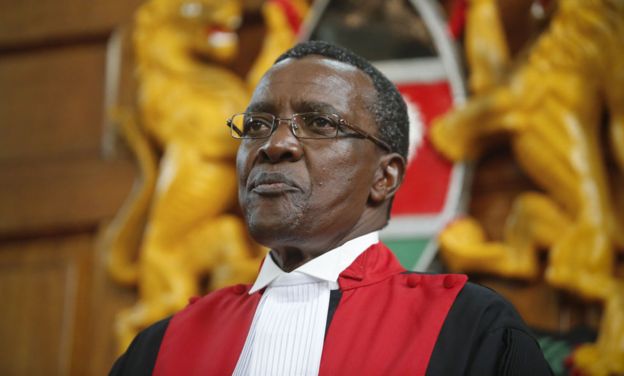
It is in this regional context that Kenya's Chief Justice, David Maraga, emerges for many - if not for President Kenyatta's supporters - as a man of great courage.
The Supreme Court's decision to annul the elections because of irregularities in the electoral process, told the world that this Kenyan court would not accept a second-class democracy. Across Africa there was a sense of pride in this singular decision. Maraga was seen as speaking for the many who still stand for and demand accountable rulers and an independent civil service.
Since the Supreme Court decision tension has steadily risen. Elections are set for Thursday, but the opposition leader Raila Odinga refuses to take part.
It is possible to simultaneously take heart from the courage of the chief justice and the changed Africa he represents, and to be deeply worried about the escalating tension gripping the country in the wake of the court's decision.
Image copyrightGETTY IMAGES
For Kenyans know that political violence often goes unpunished, particularly when the instigators are powerful people. So, often, does brazen corruption. The long struggle is not between political elites at the polling booth. It is a fight waged by a still resourceful civil society, independent judges and honest political campaigners to demand accountability.
The conduct of these elections and what happens in their aftermath matters hugely to Kenyans, millions of other Africans and the broader international community. An unstable Kenya has serious implications for the fight against terrorism in Somalia and, potentially, for the aid operations in South Sudan.
A peaceful resolution to this democratic crisis would be an example to the continent. Mr Githongo told me that "democracy is entering a dark tunnel but there might just be light at the other side".
The struggle to protect the gains made by honest men and women across this region is entering a critical phase.
Tuesday, 24 October 2017
Two days until the Kenyan election re-run .....
I've been reading the news from Kenya with a feeling of fore-boding .... and today, I received an email from a good friend, a Luo, who lives in Nairobi.
He says:-
"Truth be said, I don't feel safe in my country any more. The tribal divisions have never been this bad.
The IEBC chairman himself confessed that holding elections in such a tense environment is not wise. He also laid bare some very serious challenges the commission is facing at the moment. The truth is, the government is in charge of IEBC.
Policemen have been deployed in big numbers in Nyanza and Western. The court cases challenging the event slated on 26th are so many. I mean, we are in a total mess as a country. But we are looking to God to salvage the situation."
Let's hope that God is willing ....
(IEBC = Independent Electoral and Boundaries Commission)
He says:-
"Truth be said, I don't feel safe in my country any more. The tribal divisions have never been this bad.
The IEBC chairman himself confessed that holding elections in such a tense environment is not wise. He also laid bare some very serious challenges the commission is facing at the moment. The truth is, the government is in charge of IEBC.
Policemen have been deployed in big numbers in Nyanza and Western. The court cases challenging the event slated on 26th are so many. I mean, we are in a total mess as a country. But we are looking to God to salvage the situation."
Let's hope that God is willing ....
(IEBC = Independent Electoral and Boundaries Commission)
Monday, 16 October 2017
Only in Africa, (5)
Today, working in the HATW office, I was booking flights for volunteers going to Rwanda. This prompted a discussion on 'worst flights' !!
One story was about a flight 30 years ago from a small airport in Zambia, where a group of about 25 medics were going on a half hour flight to another part of the country; the plane had been over-booked, but that didn't deter the crew .... or the medics. They crowded onto the plane, and were seated two to a seat, with a few sitting on the floor in the aisle ! On their return flight, several of the medics managed to hitch a lift on a small plane back to Lusaka .... only for it to abort take off, as a tyre burst on the runway. It took two days for a new tyre to be sent by road from Lusaka .....
Then there was the flight somewhere in west Africa, which was a bit bumpy, and the sick bag might have been needed .... but the passenger discovered the bag had already been used, and put back. The stewardess was asked for another bag .... she checked the bag, and commented "But its not full .... you can still use it !"
My favourite from this office chat was that somewhere in central Africa, it often happened that a plane about to land had to skim the runway before going round again ... in order to scare the elephants off the runway !
Only in Africa ...........
One story was about a flight 30 years ago from a small airport in Zambia, where a group of about 25 medics were going on a half hour flight to another part of the country; the plane had been over-booked, but that didn't deter the crew .... or the medics. They crowded onto the plane, and were seated two to a seat, with a few sitting on the floor in the aisle ! On their return flight, several of the medics managed to hitch a lift on a small plane back to Lusaka .... only for it to abort take off, as a tyre burst on the runway. It took two days for a new tyre to be sent by road from Lusaka .....
Then there was the flight somewhere in west Africa, which was a bit bumpy, and the sick bag might have been needed .... but the passenger discovered the bag had already been used, and put back. The stewardess was asked for another bag .... she checked the bag, and commented "But its not full .... you can still use it !"
My favourite from this office chat was that somewhere in central Africa, it often happened that a plane about to land had to skim the runway before going round again ... in order to scare the elephants off the runway !
Only in Africa ...........
Wednesday, 11 October 2017
Sadly, so very true.
"When
the missionaries came to Africa they had the Bible and we had the
land.
They said 'Let us pray.' We closed our eyes and prayed.
When we opened
them again we had the Bible and they had the land."
Desmond
Tutu
Tuesday, 10 October 2017
Raila Odinga has pulled out of this months election ..............
Kenyan
opposition leader Raila Odinga has pulled out of October's election
re-run. (From BBC Africa news site)
Mr
Odinga said his withdrawal would give the electoral commission enough
time to introduce reforms that will help deliver a more credible
election. The Supreme Court annulled the result of the original 8
August poll, which saw Uhuru Kenyatta declared winner, after finding
irregularities. But Mr Kenyatta says he is ready to proceed with the
new vote as planned.
The
country's electoral commission said Mr Kenyatta had won the August
vote by a margin of 1.4 million votes - or 54% of the total, compared
to Mr Odinga's 44%. Kenya's vice-president, William Ruto, has now
called on the commission to declare Mr Kenyatta president as a result
of Mr Odinga's announcement.
The
election re-run was due to take place on 26 October, but Mr Odinga
said on Tuesday: "We have come to the conclusion that there is
no intention on the part of the IEBC [electoral commission] to
undertake any changes to its operations and personnel. All
indications are that the election scheduled for 26 October will be
worse than the previous one." As a result, he said,
"considering the interests of the people of Kenya, the region
and the world at large" it was best that he withdrew from the
race.
Mr
Odinga's coalition party believes the election will have to be
cancelled as a result of his withdrawal, allowing "adequate time
to undertake the reforms necessary to conduct an election that is in
strict conformity with the constitution, the relevant laws and the
constitution".
But
Mr Kenyatta, speaking at a rally in the southern town of Voi, said:
"We have no problem going back to elections. We are sure we will
get more votes than the last time."
He
added: "We are also telling him it is the people's right to
choose their leader. It is their sovereign right to choose their
leader of choice."
#
# # #
Uncharted
territory By Dickens Olewe, BBC News
The
withdrawal could be a strategy for Raila Odinga to exit the political
scene on his own terms. The annulment of President Uhuru Kenyatta's
victory in the 8 August election was a much-needed political high for
Mr Odinga.
He
felt vindicated for challenging the election and pushed for changes
to the electoral system as a condition for his participation in the
re-run. The electoral commission has rejected the changes he
demanded, largely because of contractual agreements with the
companies providing key services for the election.
With
President Kenyatta's party having won a majority of MPs in both
houses of parliament, it is likely that Mr Odinga was headed for
another defeat and that would be too much for a man, who has been
nicknamed 'the enigma'
The
legal consequences of Mr Odinga's withdrawal are unclear.
Constitutional lawyers disagree on the way forward and whether the 26
October election can still take place and if, despite his withdrawal,
Mr Odinga will still be on the ballot.
Although
many Kenyans are jaded by the never-ending political drama, they will
now have to belt-up for a drive further into unchartered territory.
Mr
Odinga's opposition coalition - the National Super Alliance (NASA) -
has previously made clear its participation in the election was
contingent on reforms being made. But Kenya's Independent Electoral
and Boundaries Commission (IEBC) says it has made the necessary
changes.
Prominent
opposition senator James Orengo has called on people to protest on
Wednesday, using the slogan "no reform, no elections".
Some animals ....
As a change from politics, I thought I'd show readers some of the animals (and a man !) I have identified and counted for the 'Zooniverse' site I mentioned some time ago. (These are from an un-named site somewhere in northern Kenya; possibly in the Samburu area).
Firstly, a secretary bird, or part of, and a guinea fowl
Two 'screen shots' of the delicate small antelope, the dik-dik. Not much bigger than, say, a Siamese cat.
A reticulated giraffe with an oxpecker about to land !
The very delicate legs of a gerenuk .
| A Samburu man with his goats walking past and being 'snapped' by the camera trap |
Warthog |
(The spacing has for some reason, gone haywire, but I hope the screen shots are interesting).
Friday, 6 October 2017
The Bible has taken centre stage in the battle for the Kenyan presidency.
A BBC news report from Kenyan reporter, Joseph Warungu:-
If opposition leader Raila Odinga contests and wins the presidential election re-run on 26 October, a large chunk of the Kenyan population will be about to enter the biblical land of Canaan.
This is because Mr Odinga has succeeded in boiling down the entire manifesto of his umbrella group of opposition parties into a single memorable phrase - "tunaenda Kanani" - Swahili for "we're going to Canaan", the land that flows with milk and honey.
Presidential elections in Kenya have become a complex affair. In the past it was enough to shout yourself hoarse on campaign platforms, lock up or silence your critics, change the constitution at will, distribute a few goodies to supporters and you would wake up at State House. Now you need a multi-million dollar budget to hire helicopters, control the media, buy out political parties, patrol the digital space viciously and consult the best traditional herbalists.
In addition, you have to know your Bible well in the search for special anointing.
And so Mr Odinga - the presidential candidate of the National Super Alliance (Nasa) - has carefully studied the Book of Joshua and cast himself in the role of the famous hero who succeeded Moses, and led the fight to liberate enemy territory and settle the Israelites in the new land.
Meanwhile, President Uhuru Kenyatta and his deputy William Ruto, who are seeking re-election, must be suffering from sore knees, as they have moved from church to church kneeling before men of God, who lay hands on them and give them the anointing. Mr Ruto has been at the centre of a spiritual storm as leaders of the Pentecostal Assemblies of God try to interpret what his recent donation to them of 10m Kenyan shillings ($68,000, £51,000) could mean. Some say it was gift for the development of the church, while others argue it was a political tithe to sway them to vote for his Jubilee Party.
In a country where people's hopes for a better future have often been crushed by bad politics, endemic corruption and deep-seated tribalism, many Kenyans have always put their faith in God. He is the only constant and unchanging force for good. When faced with any calamity, Kenyans have been known to go on their knees to seek God's intervention in mammoth prayer meetings that are broadcast live on the media. The politicians have woken up to the fact that they live in a nation of believers and to reach them you need to be seen to be God-fearing.
In May, newspapers published a photo of Mr Odinga praying at the historic Western Wall in Jerusalem, during a visit to Israel. Mr Odinga explained that the Wailing Wall was more than 5,000 years old and was sacred to all three Abrahamic religions - Islam, Judaism and Christianity - and that to him it was a very strong symbol of strength and unity.
With the rival presidential candidates keeping their Bibles close to their chest, Kenyans have been on the look out for any divine sign that could help them decide which of the two is the anointed one. Earlier this year, President Kenyatta caused an online tremor when he became a "rainmaker".
On a voter registration drive in Nyeri in central Kenya, the crowd urged the president to pray for rain in the area, which had experienced a drought. Minutes after he reluctantly prayed, there was a heavy downpour, prompting animated reactions on social media. One contributor said: "Our president is not only a leader but a prophet!"
To counter Mr Odinga's metaphorical journey to Canaan, supporters of President Kenyatta, who is left-handed, have also delved into the Bible for inspiration and likened their candidate to King David. The Jubilee Party faithful have gone to the Book of Judges, which refers to 700 left-handed soldiers from the tribe of Benjamin being excellent in the use of the sling as a tool of war. David too was an expert with the catapult and some therefore argue he must have been left-handed. And so images of President Kenyatta writing with his left hand have done the rounds on WhatsApp to confirm his leadership credentials.
The Bible was at the centre of a political storm again when angry bees attacked police and protesters outside the Supreme Court on 20 September, as judges gave their full ruling for annulling the August election, saying that it was marred by irregularities. In response to the incident, opposition supporters quickly began to share a verse from the Book of Exodus that says: "And I will send the bees ahead of you to drive your enemies out of your way."
With the electoral commission announcing a new date for the presidential poll, social media platforms, are again awash with biblical messages and prayers for the two main candidates. A number of prayers shared on WhatsApp from both sides of the political divide are Bible-based but with violent overtones. The intention is to stir up ethnic hatred and use the Bible as a legitimate weapon of war.
President Kenyatta entered the race with a prayer from the Book of Nehemiah that he shared in a live radio interview: "Remember me with favour, my God, for all I have done for these people."
Mr Odinga ended his Supreme Court battle with the Book of Joshua: "Our journey to Canaan is unstoppable," he said. "On 8 August we crossed the River Jordan to reach the city of Jericho. We are marching on to the city of Jerusalem, and we shall get there."
I am not quite sure what Israeli Prime Minister Benjamin Netanyahu will make of the Kenyan invasion, but presumably Israel's intelligence agency, Mossad, has armed him with the appropriate Bible verses.
However, whether it is Joshua, in the form of Mr Odinga, or King David, in the form of Mr Kenyatta, who wins the re-run, many Kenyans will hope and pray that the candidates will heed the [ Gospel ? ] of Peter: "Whoever would love life and see good days must keep his tongue from evil… he must seek peace and pursue it."
Monday, 2 October 2017
Its been a while .....
... since I blogged, but I've been contemplating the forthcoming elections in Kenya, with some concern and trepidation, for one party will 'win' and the loser won't like it. Remember the awful riots, deaths and displaced persons following the aftermath of the elections ten years ago ?
On my visit this year in March, I noticed that some of the buildings that were burned and partially destroyed following the 2007 election, caused by inter-ethnic violence, were still standing as stark reminders of what ensued and warnings of what might yet happen.
"Bright dawn broke over the Ngong Hills. The air on the hills was clear and there was a bite on the early morning breeze lazily moving through the thorn scrub and euphorbias. Far below on the arid African plains, a slight shimmer, a heat haze could be seen, promise of another hot, dry day to come. The wildebeest, zebra and gazelles were moving in the distance; vultures and eagles started to rise and soar in the already warm air, and nearby, on a rocky outcrop, was a small Maasai manyatta of low dwellings, made of branches and animals skins, and plastered with dung. Young children were driving the cattle and goats out from the surrounding thorn enclosure, for a days grazing among the wilder inhabitants down on the plain. Their shrill voices calling to one another rose on the breeze - 'Na kitok - takuenya - sere !'
On my visit this year in March, I noticed that some of the buildings that were burned and partially destroyed following the 2007 election, caused by inter-ethnic violence, were still standing as stark reminders of what ensued and warnings of what might yet happen.
~ ~ ~ ~ ~
Yesterday, sorting through ancient computer files, looking for something else, I found this story:-
"Bright dawn broke over the Ngong Hills. The air on the hills was clear and there was a bite on the early morning breeze lazily moving through the thorn scrub and euphorbias. Far below on the arid African plains, a slight shimmer, a heat haze could be seen, promise of another hot, dry day to come. The wildebeest, zebra and gazelles were moving in the distance; vultures and eagles started to rise and soar in the already warm air, and nearby, on a rocky outcrop, was a small Maasai manyatta of low dwellings, made of branches and animals skins, and plastered with dung. Young children were driving the cattle and goats out from the surrounding thorn enclosure, for a days grazing among the wilder inhabitants down on the plain. Their shrill voices calling to one another rose on the breeze - 'Na kitok - takuenya - sere !'
Today
was a special day for the morani. It was the day that Ololokwe had to
go and prove his manliness, with his 'brothers' of the same age
group. Long before he could become a tribal elder, he had to hunt and
find a lion to kill, so that he could wear the much coveted lions
mane head-dress he so admired in the other, older morani. His friends
came to his hut, and together they left the compound, wearing little
but beads, a red cloth and rough leather sandals, their bodies
covered in the greasy red ochre, which as well as being so attractive
to the girls, also kept off the biting flies. They each carried their
spears, a stout stick and a knife, and very important, two dirty
leather gourd, one containing water, and the other the clotted
mixture of ox-blood, milk and urine which would sustain them until
they returned home, successful or not, in several days time.
They
quickly trotted across the hillside, tall, lithe, naked and beautiful
young men, with not an ounce of fat on them, muscles rippling under
their reddened skin. They could maintain the shuffling trot for hours
on end. They passed through the dry grass, their feet making a soft
sliding sound, as the leather of their sandals slid over the dead
thorns and twigs, and the parched, brittle grass. They sang as they
went, a guttural almost wordless chant, and then soon fell silent as
they made their way down among the rocks, between which grew small
thorny shrubs, tufts of apparently dead grasses, small flowering
plants, which at this time of the year were covered in dried
seed-pods, and the occasional lush looking cactus. The rocks impeded
their trotting, and they had to scramble and climb down to the plain,
but once away from the Ngong, they were able to resume the pace they
had set up as they left the manyatta.
After
a few hours, the group of young men stopped by a small muddy water
hole to rest and drink, and squatted under a tall thorn tree in its
dappled shade, to consider their plans. Ololokwe and his cousin
Oltukai had been in this place recently, but had seen no trace of
lion, though with very few gazelles and little water in the area,
they were not surprised by this. They decided to strike south,
towards Olorgosaillie and the dry lake bed there, just north of
Maji-ya-Magadi (the bitter lake), where they knew that lions often
rested among the short but dense scrub, to escape the heat of the
day.
That
night, they slept at the manyatta of kinsmen, cooking and sharing
with them a young impala they had chased and speared on the way. True
to the Maasai code of hospitality, they were offered the choice of
the young girls for the night, and Oltukai gratefully accepted but
Ololokwe refused, preferring to wait until he had killed his lion and
could return home to impress the beautiful Serengai, who was soon to
deliver his child, and whom he wanted to take as his first wife.
Next
morning, they continued on their way, and entered an arid,
semi-desert country - the sun glinted harshly on the mica and quartz
stones, which threw the shimmering heat back into their faces. Their
feet kicked up ash and dust from the recently silent volcano, Ol
Donyo Lengai, far to the south of them, beyond the bitter salt lake,
Magadi, and they were scratched and torn by the sharp, wild sisal
plants which grew there around the ancient dry lake of Olorgosaillie.
This was a sacred place to their ancestors, with the evidence in the
knapped stones of earlier men all around them. Now they started to
see the tracks they had hoped for - lion ! They were impeded by the
denseness of the thorn scrub, but continued to track the lions for
several hours, until they stopped on a slight hillock, and one of the
men pointed up into the burning sky. There were dust devils twisting
and fading, but higher, far above them were vultures and eagles
circling in the rising heat, and now some of the birds were
spiralling down and down, to a spot a few miles away, where they
could just see many of them gathering around something on the ground.
A lion kill perhaps ?
The
young men increased their speed, and soon covered the distance,
taking extra care to be vigilant because the lion they sought must
surely be nearby. When they arrived at the place of the eagles, a
dreadful scene of violence and carnage greeted them. A young woman
was lying curled up, dead, in a slight hollow in the ground, her
water gourds scattered around her. Nearby was a dead and partly eaten
ox. Blood was everywhere. It was obvious she had unwittingly
disturbed a group of lion at the kill, an old and diseased ox that
must have strayed far from its owners, or might perhaps even have
been her animal she was taking to water. Even now the eagles and
vultures were tearing it to pieces as more and more of them, which
the Maasai called the black sons of Shetani, dropped out of the sky
to join in. A huge eagle reluctantly moved away from pecking the body
of the woman as the group of Maasai gathered around.
Ololokwe
was very aware that the lions would be back - perhaps a female had
killed and gone to collect her young from where she had left them
under some rocks, out of the heat of the day, even now guiding them
back to the kills. Danger was all around - the smell of death would
carry on the hot breeze; so much blood, soaking into the dust and
sand, would soon attract other lions, big males, who would make short
work of consuming both the dead ox and the young woman, and certainly
wouldn't hesitate to attack the group of young men. Ololokwe went up
to her and turned her body over - and his astonishment was vast - she
had been lying on a young, naked, almost new-born baby, who was still
now alive, although covered with his mothers blood. Her cloth and
beaded ornaments showed him that she was newly married, and that this
was her first child. He called over to Oltukai and asked him what
they should do, but his brother was frightened - 'I sense there is
much danger here, we should go - leave the child to the lions' - but
at that instant another of the moran called a warning - 'Simba' - the
lions were returning.
The
young men had their spears ready - they knew the lions would pick
only one of them to attack, and each was secretly determined it
wouldn't be him - this was an awful situation - their vigilance had
let them down, they should never have hunted lion in this dense thorn
scrub, where it was impossible to see far, and the bushes impeded
their movement.
Suddenly,
there was a crashing through the thorns, and a fine, mature male lion
came out of the bushes, straight towards Oltukai. The warriors all
together threw their spears at it, and all missed, but Ololokwe had
kept hold of his, hesitated for a second, and then when the lion was
in the act of springing onto Oltukai and the baby, thrust his spear
deep into the heart of the beast, bringing its leaping body down on
top of himself and away from his friend. The lion roared a terrible
roar, Ololokwe could see his huge fangs a few inches from his face,
smelt his acrid breath and looked at death in the mouth of that
powerful animal. He managed to twist to one side, just as the fangs
bit deep into his arm - and then, as suddenly as it had happened, the
lion relaxed, his damaged heart could pump no more, and he slumped
into death. The other morani helped him up from under the blood
covered body of the lion; Oltukai had carried a small snuff box with
him, containing ground up healing herbs, and they shook the powder
onto the deep wounds in Ololokwe's arm, but he was only concerned for
the baby - was it safe, and what should they do with it now ?
The
group squatted together, and decided that as it would be dark very
soon, they had better stay where they were for the night, and light a
huge fire to keep away the other lions. Three or four of the morani
gathered up the remains of the ox, and dragged them off about a
quarter of a mile, so that the lions might be distracted away from
them. The others quickly cut and cleared an area of scrub, and made a
circle of the thorny brushwood around Ololokwe's dead lion, and they
all crept inside the temporary stockade, where they lit a fire, and
huddled near it. They had nothing with which to wrap the baby, except
the cloth its mother had been wearing, which by now was dried and
stiff with her blood. They had nothing to drink, until one of the
young men remembered the woman had been collecting water, and went
and gathered her dropped gourds and they drank deeply after their
exertions.
Then
Ololokwe, who had the baby whimpering and shivering with cold at his
feet, suddenly had an idea. He went up to the lion, slit its under
belly right open with his knife, and pushed the baby into the still
warm body cavity of the animal. He managed to trickle a little water
in between the babies lips, and its condition seemed to improve with
the warmth.
The
morani shivered and slept on the ground, taking turns through the
night to keep the fire going, hearing the grunts and rasping roars of
the lions in the distance several times during the night, until dawn
came at last. Ololokwe and his brothers carefully skinned and removed
the lions huge tawny red mane, and they retrieved the by now very
hungry but warm baby. They wrapped it in the lions mane, and Ololokwe
carried him as they trotted back towards the north, towards the Ngong
and home. They stopped at the same manyatta for a nights rest, and
one of the women who had a young child of her own, cleaned and fed
the baby while they ate with their cousins.
They
were asked, what were they going to do with this child ? It seemed to
them all that the baby was in some way very special, having survived
its recent birth in that harsh land, protected by its mother even
after she had witnessed the killing of her ox, and again in her dying
at the hand of the lion. Then the babies miraculous escape from the
hungry lions and pecking vultures and eagles, hidden by his mother,
and his final rescue by the young man, Ololokwe. Mungu, their
god, had protected it, perhaps for some purpose, and so now it was
clearly their duty to care for it. Ololokwe hoped that perhaps
Serengai might adopt it and they could raise it with his child that
was due so soon.
They
reached their own manyatta late the next day, proudly bearing the
lions mane that Ololokwe would later make into a head-dress - and to
the astonishment and bewilderment of the tribal elders, bringing with
them the baby ! Loitokitok, the clan chief, questioned Ololokwe about
the hunt, his wounds, and how on earth they came to find a baby out
there on the volcanic ash-plains of Olorgosaillie. The elders decided
that Ololokwe could indeed adopt the child with Serengai, who had
given birth to a daughter while he had been away, and that
furthermore, for risking his own life to save the child and his
friend, he was to be granted the status of a tribal elder
immediately, before the rest of his age group. This was truly a great
honour, and the young men were feasted and praised late into the
night. They named the child after the place where it was found -
Olorgosaillie, which when given to a child, meant 'child of the lion'
- found as he was at a special and ancient sacred site where lions
now lived. Who could foretell what he might do for their clan in the
future ? Who could tell ?"
I
wrote this story about 16 or 17 years ago as part of a course I was
doing at the time ! Keen eyes will spot Christian
symbolism in it, but as a story, I can see now it needs more work !
Maybe one day .....
Sun setting over the Ngong hills
Subscribe to:
Posts (Atom)