I've been watching a lot of TV and DVD's whilst I've been recovering from pneumonia over Christmas, so was delighted to find this programme about one of the first elephants to be brought to Britain. https://www.bbc.co.uk/iplayer/episode/b09jcxrj/attenborough-and-the-giant-elephant It reminded me that I used to be taken to London zoo as a child, and once had a ride on an elephant there ! I assume it would have been an Indian elephant, although 'Jumbo' in this Attenborough film was an African elephant, trained to carry children on its back. Maybe that's what started my life-long passion for these animals.
Isn't this one fantastic ? The red colour comes from the red soil of Tsavo in the south east of Kenya.
And elephants about to cross the Ewaso Nyiro river in Samburu in northern Kenya ... different coloured soil = different coloured elephants !
I took my mother on a trip to The Ark in the Aberdares when she visited us .... there is a sort of underground bunker below the hotel, where visitors can get up close and personal to the elephants .... there is a dimly lit water hole/wallow by the bunker, and at night the elephants come and drink, presumably well aware of the tourists just a few feet away from them. An occasional trunk will sniff at the opening in the bunker wall ! It is wonderful to be so safely close to them, where one can hear their rumbles, smell them and almost touch them.
I've always wanted to go to Madagascar to see the lemurs, and possibly the rare aye-aye. Well I have seen lemurs .... in Jersey zoo (used to be called 'Durrell'). I've spend over an hour searching through old photos to try and find my pictures of the ring tailed lemurs they have there ... to no avail. I've got some somewhere .... (heavy sigh). But the aye aye is another matter altogether. Its a nocturnal and very strange lemur. I think Yoda of Star Wars fame must have been based on the aye-aye. They both live in the twilight zone !
(from StarWars.com)
(from National Geographic)
The aye-aye has a strange elongated middle finger, and inhabitants of Madagascar believe that if it points its finger at you, you are doomed ! But this strange lemur has a method of feeding called percussive foraging; it taps branches and listens with its huge, bat-like ears to detect any insect or grub moving within the branch. If it hears anything, then it quickly gnaws a hole in the wood, and uses the middle finger to pick out the grub. The aye-aye fills the niche that woodpeckers normally fill, for they employ the same tap and listen technique. Luckily, there are no woodpeckers on Madagascar !
I've been lucky enough to see aye-ayes in Jersey zoo ... they live in virtual darkness so when you enter their domain, you can't see a thing, until your eyes get used to the lack of light. A faint red light barely illuminates their house, but after a while, you can see them running along branches, like a scruffy animated old thread-bare rug. I have to say .... they also smell pretty bad too !
My friends on the cruise have got as far as Mombasa, and they have booked a quick trip along the northern coast, to Gedi. Its probably almost 50 years since I was last there, and according to various internet sites, it now seems to have become a national park with the inevitable museum ! It was just a ruined city in the Arabuko-Sokoke Forest when we were there, and I seem to remember we either camped in the ruins or nearby. It was a medieval/Arab town, near where I mentioned the elephant shrew in http://luolaughter.blogspot.co.uk/2017/07/only-in-africa-3.html
Gedi Palace entrance
Main gate to Gedi Palace
These photos almost 50 years old . But they convey the sense of mystery these ruins had, hidden away, getting overgrown and reclaimed by the forest.
I'm hoping my friends will have lots of new pictures; it'll be interesting to see if more ruins have been reclaimed.
An hexagonal pillar tomb ...
... and the Mihrab of the Great Mosque (not sure what that is).
Friends of mine are just leaving the Seychelles today to go on a wonderful cruise .... Mombasa, Madagascar, Mozambique, South Africa and various other stopping points. I am positively GREEN with envy ! I hope they send me photos ...... watch this space !
Goodness, but its three weeks since I posted. * Kenya seems to be calming down, even with a very minority elected president. * Zimbabwe has said goodbye to President Mugabe. AND .... Archbishop John Sentamu of York, has replaced his dog collar ! He took it off and cut it up just about ten years ago to the day, as a protest against the rule of ex-president Mugabe, whom he said had"taken people's identity and cut it to pieces", prompting him to do the same with his dog collar.
I have heard from my friends Fathers Hans and Gerry, from Kisumu, but now both retired and living in Holland. I sent them both Duchy organic Christmas puddings, which arrived safely !
Hands Around the World has been busy with local Christmas fairs, at which we have had sales tables. I get the impression that there is less spare money about this year; church Christmas fetes aren't taking so much money, and a friend who helps with the Poppy appeal has said they haven't taken as much as usual. Is this the Brexit Effect, I wonder ?
~ ~ ~ ~ ~
When we lived for a couple of years in sight of Lake Nakuru, we used to get what we called 'Pelican Days'. Great strings of literally hundreds of the birds flying in classic V-formation over our house; we assumed moving from the lake to another lake fifty miles north in the Rift Valley. An unforgetable and amazing sight and sound.
I decided as a present I would send a little individual Christmas pud each to two of the retired Dutch Mill Hill Fathers (now resident in Holland). I used to take them one when I visited Kisumu each year. They love English Christmas pudding .... and very suitable as a treat for Sinterklaas on December 6th.
(Father Hans tucking in !)
But a small pudding wrapped up looks a bit like a hand grenade, which is NOT allowed in the post, so I made enquiries at our local post office. The enquiry was treated with some amusement, but 'hakuna matata' !! No problem ! Its perfectly legal to send Christmas puddings through the post to Europe !! Live and learn .......
I have been trying to find the source of the quote I used the other day (25th October) .... "I weep for Africa ... " ... and Google helped, Amazon provided the book in record time, and now I have found another poem I've heard before .... "I am an African ..."
Well, no ! But there is talk of perhaps talking about the possibility at some point in the future. The recent re-election was a shambles; President Kenyatta was re-elected by, some say, about 90% of the votes. BUT .... large parts of western Kenya and some of the northern areas didn't have a re-election at all, so to say the winner got 90% of the votes should really say that he got 90% of the total votes cast, but that 30 or more per cent of the population didn't have the opportunity to vote, and others boycotted the vote anyway, because of fear ?. They were denied their democratic right due to the violence, killings, threats and lack of polling stations and officials, and just plain fear of being seen to vote. And as well there was the call from the opposition leader to boycott the election, which the courts had suggested wasn't democratic or as set out in the constitution. So is secession likely ? It clearly hasn't worked in South Sudan, which is in the grips of a violent civil war, with people starving and homeless. Would it work in Spain, with Catalonia wanting to break away ? There has been a referendum on Kurdish independence in Iraq, and there is growing support for self-determination in the Anglophone regions of Cameroon. And isn't the British desire for 'Brexit' a similar movement ? The phrase "United we stand, divided we fall" comes to mind. Division would be a disaster for Kenya and could even mean dividing the country into four or five separate countries, split along tribal lines. Crazy !!
Apart from reading what the BBC and the Kenyan newspapers are saying about the election, I have had an email from a (white) missionary friend who lives near Kisumu. Here's an extract of what he has said to me today, after I quoted to him what my Luo friend had written to me a few days ago:- (I've added a couple of explanatory links).
"I echo your friends sentiments, no one feels safe. Uhuru and his people are using Mungiki https://en.wikipedia.org/wiki/Mungiki in police uniforms to harrass, batter and kill Luos. Today in Kisumu alone there were 200 armed police. l had hoped after Dr Akombe http://www.nation.co.ke/news/IEBC-commissioner-Roselyn-Akombe-resigns/1056-4144480-7lyoqhz/index.html ran for her life and said what she did, backed by the Chairman of the IEBC, that people would stop and think and the election would be postponed, instead even UK and USA embassies pushed for it to go ahead. The helicoptor that crashed in Lake Nakuru was full of ballot papers. The same people who rigged the election before are still in place.
l hate the Demos, but if you speak out, you are dead. A Catholic priest spoke out about the Luo killings by the police; he disappeared that day and was found out near Kibos with cuts to head and body, car burnt out and he died at the Russian Hospital. He had no ID or identity on him, why would anyone want to kill a harmless priest? Its become a police state and they are determined to have their way, but a lot of blood is on their hands, and God won't listen to our prayers.
I was here in 2007 and 2008, tribalism has brought hatred and division to Kenya and l worry about the amount of ethnic violence; we could have another Rwanda erupt, as people here are so angry and refusing to recognise Uhuru or his ministers. They have said no Demos, no burning tyres, but it continues, where it will all end ? l am so worried for them; l'm more African than English and they are like my own family and people, they are suffering, but determined to make a stand. l just pray that God will bring justice and intervene in the events here."
~ ~ ~ ~ ~
And the election for the four counties of Homa Bay, Migori, Siaya and Kisumu which WAS going to be held on Saturday (tomorrow) has again been postponed to a date as yet to be announced, for security reasons.
Its cynical to report that not many people were killed by the police/armed forces today, but I suppose it could have been far worse. Four counties, Homa Bay, Migori, Siaya and including the city of Kisumu constituencies, in the Luo dominated west of the country, had no voting for a variety of reasons .... ballot papers hadn't been delivered; officials had stayed away after threats on their lives; there were no ballot boxes, and several other reasons ... including the call by the NASA (opposition) leader, Raila Odinga, to boycott the re-run election because the Supreme Court had not yet delivered a final ruling on the August election. It has been said that voting in these counties will now take place on Saturday.
Armed Police looking for protesters in the Kibera slum, Nairobi
Protests, riots and demonstrations took place in many areas of NASA support, including Kibera in Nairobi, Mombasa and all over Kisumu .... I heard later today that someone was shot in Mamboleo, where I have friends, and also in the Nyalenda slum, where I used to go on a Sunday evening to play the Dutch game shulbach, with Father Hans and African friends.
So what are the implications of this election ? Well, corruption and the 'big men' having Swiss bank accounts into which they pour ill-gotten fortunes, are just a way of life in most African countries, as is the grinding poverty of the majority. But as Fergal Keane said in the report I posted yesterday, the implications don't only affect Kenya, they have serious implications for the fight against terrorism in Somalia and, potentially, for the aid operations in South Sudan.
What will happen after the extra voting (if it goes ahead) on Saturday ? We wait with bated breath ....
.... one from the Kenyan friend I quoted yesterday; he tells me that he and his family are on lock-down in their house in Nairobi. I assume that he is typical of many Luo living in what is mostly an 'opposition' area, fearing what might happen if he goes out on the streets.
~ ~ ~ ~ ~
And another email, from an ex-Kenya retired priest friend in Holland, tells me that a priest has been murdered near Kisumu. I checked in the Daily Nation and found this report:-
"A Catholic priest died on Monday night after he was found unconscious near a sugar plantation in Kisumu East. Father Evans Juma Odour, the Presiding Priest of Nyabondo Parish in Nyakach, was found unconscious with deep cuts on the head, face and hands. He was rushed to Jaramogi Oginga Odinga Teaching and Referral Hospital where he was pronounced dead.
The cleric is said to have been carjacked and tortured by unknown assailants who dumped him at the sugar plantation then drove his car to a different location and set it ablaze.
According to a relative who did not want to be named the priest had dropped her at Chiga and was on his way back to Nyabondo when he was accosted by his killers. Shocked congregants took to social media and expressed their anger at the manner in which the cleric was felled. ”Why kill the man of God, it is so sad. We were recently with him at a funeral of a relative, very calm and collected man,” said Jane Nyagingo."
~ ~ ~ ~ ~
... and then there is the report about the non-fatal shooting of the driver/body-guard of a deputy chief justice ....
This week's presidential election re-run in Kenya has implications not only for the country but also for much of the continent, says the BBC's new Africa editor, Fergal Keane.
The last days have passed in a swirl of chanting crowds, arguments in the courts, and meetings between powerful politicians and election commissioners. The tension ahead of the polls crackles like static on the streets of Nairobi.
At the Githurai junction on the city's outskirts, several thousand people gathered to cheer President Uhuru Kenyatta. Passing cars were surrounded and plastered with party stickers. Briefly enmity flared. A man leaned out of a passing coach and drew his finger across his throat, shouting abuse at the President's supporters. They surged forward but bus and man were quickly gone.
The days tremble with rumours. The election may happen. Or it may not. The Independent Election Boundaries Commission has warned it can't guarantee a credible poll in the prevailing circumstances.
Old friends I have spoken with express alarm at the rise in ethnic antagonism. International diplomats seem in a quandary - fearful of election day violence while acknowledging that the fresh poll was ordered by the country's highest court.
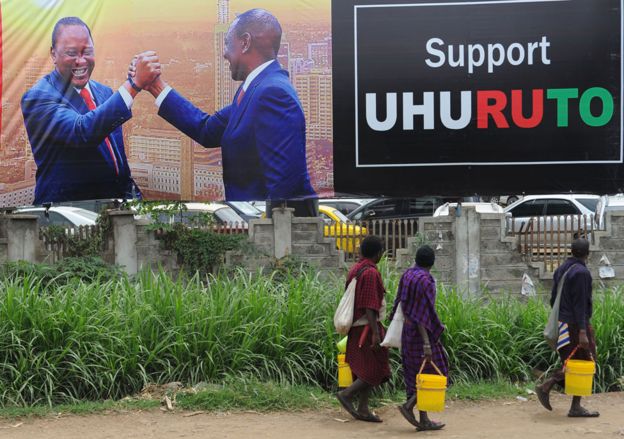
Image copyrightGETTY IMAGESImage captionA billboard urges Kenyans to support President Uhuru Kenyatta in the forthcoming election
When I first reported from Africa, back in the Cold War days of the 1980s, there were only very occasional elections, usually resulting in the return of the incumbent with 90% or more of the vote.
So when Kenya had its first democratic election in 1992, it was easy to be carried along by enthusiasm for the new age. After all, President Daniel arap Moi had been in power for 14 years, during which time there had been a long spree of looting of state assets, worth billions, by an entrenched elite connected to the ruling party.
Political enemies were locked up and worse. But Moi was elected - twice. He knew how to manipulate tribal rivalries to his advantage - and his party machine had very deep pockets. Still there was now at least the possibility of democratic change.
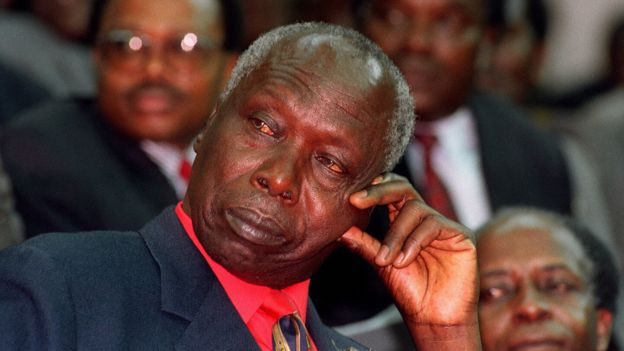
Image copyrightGETTY IMAGESImage captionPresident Daniel arap Moi, pictured in 1992
Across Africa it seemed as if a new order of accountability was coming. The great kleptocrat Mobutu Sese Seko had been swept from power in the Democratic Republic of Congo. The apartheid state in South Africa was transformed into a multi-racial democracy.
I had met Mobutu and Moi and the leaders of the apartheid regime in South Africa and witnessed the brutality and bribery through which power was maintained in much of the continent. I had also listened to diplomats, among them representatives of Her Majesty's government, tell me that President Moi at least guaranteed stability in Kenya. He kept the tribes from tearing each other asunder.
The French would have told you the same thing about any of the despots they supported in Francophone Africa. It was an attitude of mind rooted in deeply patronising attitudes towards Africans, and it ignored the role of foreign interests in creating much of the mess
But Africans were hungry for change. The Cold War had ended and with it the sorry history of support for despotic regimes by both the West and the Soviet bloc. Some of the new leaders came to power through war, but in those heady days of the late 1990s all the talk was of democratising.
The most remarkable movement in the continent's post-colonial history was not led by warlords or tribal chiefs but by a generation of Africans who believed their destiny would be shaped by their own actions. From Accra to Johannesburg to Nairobi, and thousands of points in-between, civil society began to mobilise.
I watched the Kenyan campaigner John Githongo forensically detail the corruption of the ruling elite and publish his results. In the remote Congolese village of Kachanga I met a women's association treating victims of mass rape and gathering evidence against the perpetrators.
The idealistic and energetic also mobilised around issues like the environment, economy, health and free media. The pace and dynamics of change were dictated by the internal realities of each state. But an overarching theme became apparent - the one-party state was becoming the exception.
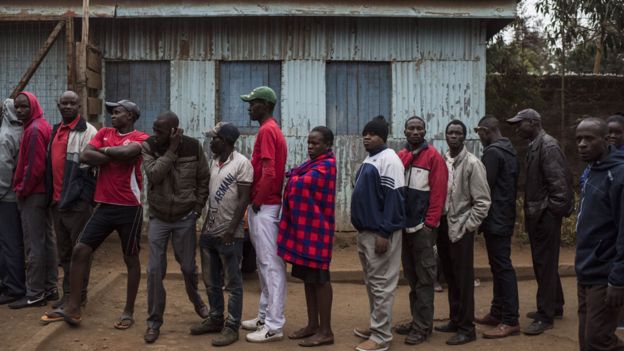
Image copyrightGETTY IMAGESImage captionNairobi, August 2017: Voters queuing for the polling booths
The essential change was psychological. Young Africans saw themselves becoming agents of change much as their forebears had done in the years around, and just after, the end of colonialism. Two decades ago I could not have imagined the recent peaceful elections in Liberia, a state written off as irredeemably "failed".
But in a large swathe of the continent - central, eastern and much of southern Africa - I underestimated how efficiently the elites would take control of the machinery of modern democracy.
In different places they used different tactics - some buying up media outlets to promote their cause, others bribing enemies so that they became friends or manipulating ethnic antagonism into a weapon to be used on the campaign trail, and still more changing the law to extend presidential terms or silence outspoken opponents.
Some members of the new governments merely continued the corrupt practices of the old, siphoning off millions as the moribund economies of one-party states made the transition to a free market.
In South Africa it gave rise to a new class - the so called "tenderpreneurs" - whose connections to the powerful guaranteed lucrative government contracts.
Across much of this region - from the Democratic Republic of Congo, to Uganda, Rwanda, Eritrea and others - authoritarianism is on the rise. Elections are postponed, independent media are silenced, presidential term limits are expanded and opposition figures locked up.
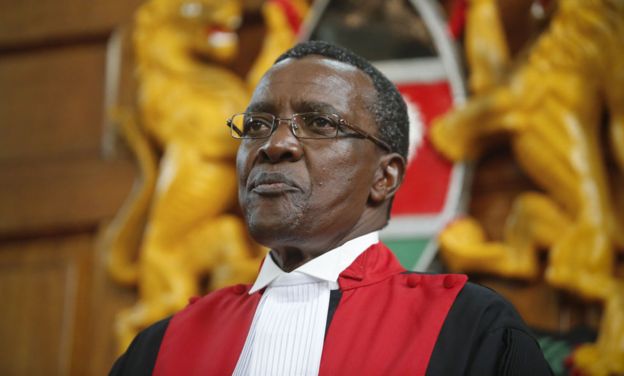
Image copyrightEPAImage captionKenyan Chief Justice David Maraga
It is in this regional context that Kenya's Chief Justice, David Maraga, emerges for many - if not for President Kenyatta's supporters - as a man of great courage.
The Supreme Court's decision to annul the elections because of irregularities in the electoral process, told the world that this Kenyan court would not accept a second-class democracy. Across Africa there was a sense of pride in this singular decision. Maraga was seen as speaking for the many who still stand for and demand accountable rulers and an independent civil service.
Since the Supreme Court decision tension has steadily risen. Elections are set for Thursday, but the opposition leader Raila Odinga refuses to take part.
It is possible to simultaneously take heart from the courage of the chief justice and the changed Africa he represents, and to be deeply worried about the escalating tension gripping the country in the wake of the court's decision.
Image copyrightGETTY IMAGESImage captionKenyan opposition leader Raila Odinga is refusing to take part in the election
For Kenyans know that political violence often goes unpunished, particularly when the instigators are powerful people. So, often, does brazen corruption. The long struggle is not between political elites at the polling booth. It is a fight waged by a still resourceful civil society, independent judges and honest political campaigners to demand accountability.
The conduct of these elections and what happens in their aftermath matters hugely to Kenyans, millions of other Africans and the broader international community. An unstable Kenya has serious implications for the fight against terrorism in Somalia and, potentially, for the aid operations in South Sudan.
A peaceful resolution to this democratic crisis would be an example to the continent. Mr Githongo told me that "democracy is entering a dark tunnel but there might just be light at the other side".
The struggle to protect the gains made by honest men and women across this region is entering a critical phase.
I've been reading the news from Kenya with a feeling of fore-boding .... and today, I received an email from a good friend, a Luo, who lives in Nairobi. He says:- "Truth be said, I don't feel safe in my country any more. The tribal divisions have never been this bad. The IEBC chairman himself confessed that holding elections in such a tense environment is not wise. He also laid bare some very serious challenges the commission is facing at the moment. The truth is, the government is in charge of IEBC. Policemen have been deployed in big numbers in Nyanza and Western. The court cases challenging the event slated on 26th are so many. I mean, we are in a total mess as a country. But we are looking to God to salvage the situation." Let's hope that God is willing .... (IEBC = Independent Electoral and Boundaries Commission)
Today, working in the HATW office, I was booking flights for volunteers going to Rwanda. This prompted a discussion on 'worst flights' !! One story was about a flight 30 years ago from a small airport in Zambia, where a group of about 25 medics were going on a half hour flight to another part of the country; the plane had been over-booked, but that didn't deter the crew .... or the medics. They crowded onto the plane, and were seated two to a seat, with a few sitting on the floor in the aisle ! On their return flight, several of the medics managed to hitch a lift on a small plane back to Lusaka .... only for it to abort take off, as a tyre burst on the runway. It took two days for a new tyre to be sent by road from Lusaka ..... Then there was the flight somewhere in west Africa, which was a bit bumpy, and the sick bag might have been needed .... but the passenger discovered the bag had already been used, and put back. The stewardess was asked for another bag .... she checked the bag, and commented "But its not full .... you can still use it !" My favourite from this office chat was that somewhere in central Africa, it often happened that a plane about to land had to skim the runway before going round again ... in order to scare the elephants off the runway ! Only in Africa ...........
Kenyan
opposition leader Raila Odinga has pulled out of October's election
re-run. (From BBC Africa news site)
Mr
Odinga said his withdrawal would give the electoral commission enough
time to introduce reforms that will help deliver a more credible
election. The Supreme Court annulled the result of the original 8
August poll, which saw Uhuru Kenyatta declared winner, after finding
irregularities. But Mr Kenyatta says he is ready to proceed with the
new vote as planned.
The
country's electoral commission said Mr Kenyatta had won the August
vote by a margin of 1.4 million votes - or 54% of the total, compared
to Mr Odinga's 44%. Kenya's vice-president, William Ruto, has now
called on the commission to declare Mr Kenyatta president as a result
of Mr Odinga's announcement.
The
election re-run was due to take place on 26 October, but Mr Odinga
said on Tuesday: "We have come to the conclusion that there is
no intention on the part of the IEBC [electoral commission] to
undertake any changes to its operations and personnel. All
indications are that the election scheduled for 26 October will be
worse than the previous one." As a result, he said,
"considering the interests of the people of Kenya, the region
and the world at large" it was best that he withdrew from the
race.
Mr
Odinga's coalition party believes the election will have to be
cancelled as a result of his withdrawal, allowing "adequate time
to undertake the reforms necessary to conduct an election that is in
strict conformity with the constitution, the relevant laws and the
constitution".
But
Mr Kenyatta, speaking at a rally in the southern town of Voi, said:
"We have no problem going back to elections. We are sure we will
get more votes than the last time."
He
added: "We are also telling him it is the people's right to
choose their leader. It is their sovereign right to choose their
leader of choice."
#
# # #
Uncharted
territory By Dickens Olewe, BBC News
The
withdrawal could be a strategy for Raila Odinga to exit the political
scene on his own terms. The annulment of President Uhuru Kenyatta's
victory in the 8 August election was a much-needed political high for
Mr Odinga.
He
felt vindicated for challenging the election and pushed for changes
to the electoral system as a condition for his participation in the
re-run. The electoral commission has rejected the changes he
demanded, largely because of contractual agreements with the
companies providing key services for the election.
With
President Kenyatta's party having won a majority of MPs in both
houses of parliament, it is likely that Mr Odinga was headed for
another defeat and that would be too much for a man, who has been
nicknamed 'the enigma'
The
legal consequences of Mr Odinga's withdrawal are unclear.
Constitutional lawyers disagree on the way forward and whether the 26
October election can still take place and if, despite his withdrawal,
Mr Odinga will still be on the ballot.
Although
many Kenyans are jaded by the never-ending political drama, they will
now have to belt-up for a drive further into unchartered territory.
Mr
Odinga's opposition coalition - the National Super Alliance (NASA) -
has previously made clear its participation in the election was
contingent on reforms being made. But Kenya's Independent Electoral
and Boundaries Commission (IEBC) says it has made the necessary
changes.
Prominent
opposition senator James Orengo has called on people to protest on
Wednesday, using the slogan "no reform, no elections".
As a change from politics, I thought I'd show readers some of the animals (and a man !) I have identified and counted for the 'Zooniverse' site I mentioned some time ago. (These are from an un-named site somewhere in northern Kenya; possibly in the Samburu area). Firstly, a secretary bird, or part of, and a guinea fowl
Two 'screen shots' of the delicate small antelope, the dik-dik. Not much bigger than, say, a Siamese cat.
A reticulated giraffe with an oxpecker about to land !
The very delicate legs of a gerenuk .
A Samburu man with his goats walking past and being 'snapped' by the camera trap
Warthog
(The spacing has for some reason, gone haywire, but I hope the screen shots are interesting).